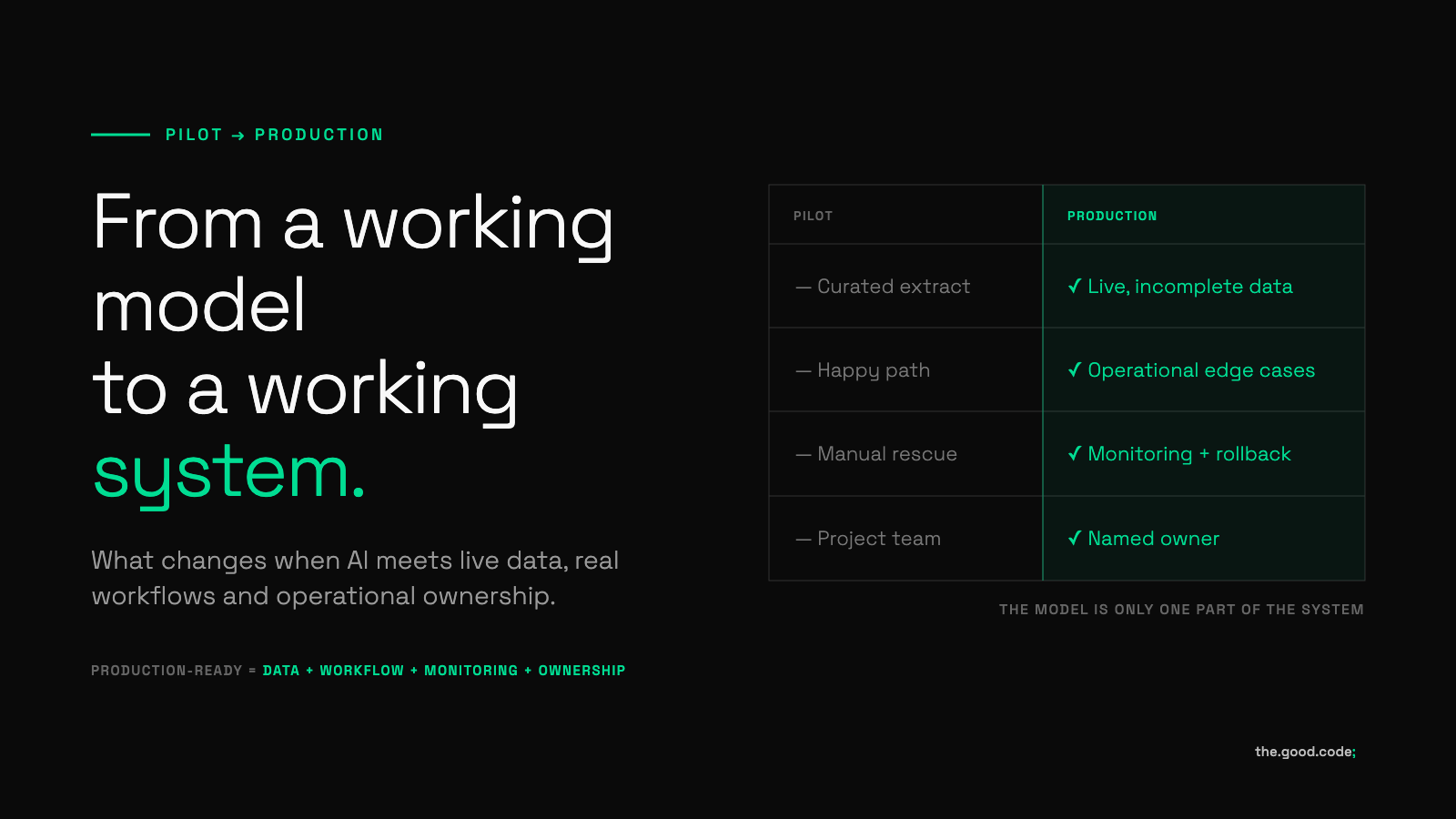
Most enterprise AI never leaves the pilot. The demo works, the board is impressed, and then the project sits for six months because nobody can get it to survive real operating conditions. The model is usually the part that works. What breaks is everything around it: the data it runs on, the process it is supposed to feed, and the question of who owns it after go-live.
Moving AI from pilot to production is an infrastructure and ownership problem before it is a modelling problem. A production-ready AI system runs on real, incomplete business data, fits an existing operational workflow instead of a clean demo path, and has a named owner accountable for it after launch. For companies with genuine operational complexity — ERP, CRM, disconnected internal tools, manual handoffs — that gap is where the money and the timeline disappear.
What production-ready means for a business system
A production-ready AI system handles real load, degrades gracefully, and can be monitored, updated and governed without breaking the operation it sits inside.
A prototype runs on curated data, serves one request at a time, and has no recovery path when something goes wrong. A production system ingests dirty and incomplete data, manages the edge cases your operation actually produces, and supports rollback when an update makes things worse. The distinction matters because the model can be sound while the platform around it is not. Data pipelines break on a schema change. Monitoring covers uptime but not output quality or drift. No one is named to fix it at 2am.
Two questions have to be true before anything goes live, and they are separate. The first is whether the model produces accurate, consistent outputs. The second is whether the platform, the team and the business process can support that model at scale, over time, without someone intervening by hand every time reality shifts. Most stalled projects pass the first and fail the second.
Why AI pilots stall before production
Three blockers account for most of the pilots that never ship, and none of them are about the model.
Data readiness. The pilot ran on a clean extract. Production runs on the live system, with the missing fields, the duplicate records and the supplier who changed their document template last quarter. Gartner has predicted that organisations will abandon 60% of AI projects through 2026 where they are not supported by AI-ready data, and found that 63% of organisations either lack the data-management practices AI needs or do not know whether they have them [4]. This is the single most common reason a promising pilot dies quietly.
Process readiness. A model that produces a good output is useless if the business process around it is not ready to act on that output. If a prediction lands in an inbox nobody owns, or contradicts a step a human still has to perform manually, the system creates work instead of removing it. The output has to change what someone actually does next.
Ownership after go-live. Pilots have enthusiastic sponsors. Production systems need a named owner accountable for performance three months later, when the drift starts and the sponsor has moved on. When we see an AI deployment degrade silently, it is almost always because accountability ended at launch.
Compliance sits underneath all three. SOC 2, GDPR data-residency rules and, in regulated sectors, HIPAA govern how data is accessed, stored and processed across the whole platform, regardless of what the model does [1]. These are architectural inputs, decided before a model is trained. Bolt them on after a compliance review begins and you rebuild significant parts of the system, which is exactly the delay that turns a 90-day project into a year.
How we move AI from pilot to production
We treat the surrounding system — data, process and ownership — as the actual work, and we define governance during architecture rather than after go-live.
In practice that means a few things. We start from the business process the system will feed, not the model, because a model that works in isolation rarely survives contact with a real workflow. We build monitoring as a go-live prerequisite, the same way you would treat data migrations or access controls: no baseline, no launch. And we keep a named senior owner accountable after delivery, so performance is somebody's job past the launch date.
On the platform side, we build AI-native business systems on Open Mercato, which lets us stand up a working proof of concept in seven days and then extend it incrementally, without ripping out the ERP or CRM a company already runs on. Roughly 80% of the platform is in place before the first custom line of code, so the build effort goes into the 20% that is specific to the business. That incremental path is what makes production realistic for operationally complex businesses: you modernise the parts that block AI from working, and you leave the rest running. It is the same approach we took to measurable ROI in ERP and CRM modernisation, where the return came from fitting the system to the operation, not from replacing everything at once.
Governance and monitoring you set before go-live
Production AI needs four governance basics defined before launch, not retrofitted after an incident.
- Access control. Who can change a model or a prompt, and what approval a change requires.
- Audit logging. What the system decided, which inputs it received, and which path it took, so a failure can be traced to a specific release.
- Versioning. Exactly which version ran at which time.
- Incident response. A documented process for what happens when the system fails or produces a harmful output: who gets paged, what rollback looks like, and how affected users are told.
Monitoring has to be configured before go-live because without a pre-launch baseline you have no reference for what normal looks like, so you cannot detect drift. The minimum useful setup tracks input distribution, output quality, latency per request, and a scheduled evaluation against a held-out labelled set. Retrofitting this into a live system is slower, more disruptive and more expensive than building it in from the start.
Not every decision carries the same risk, so the controls should not be flat. A recommendation that misfires is recoverable with a rollback. A credit or eligibility decision may trigger regulatory review. Tier the controls: high-stakes outputs get human-in-the-loop review and stricter audit retention; low-stakes ones do not need to carry that weight. Flat governance leaves the important decisions under-protected and the trivial ones buried in process.
Frequently asked questions
How long does it take to move an AI system from pilot to production?
Most teams take three to twelve months, driven by data readiness, integration complexity and governance requirements rather than the model. A well-scoped pilot with clean pipelines and a defined owner can reach production in under 90 days. The common delay is the surrounding work: monitoring, access controls, rollback procedures, and the process changes that make the output actionable.
What is the difference between MLOps and GenAIOps?
MLOps covers training, versioning and deploying traditional machine-learning models. GenAIOps extends those practices to generative systems, adding prompt management, output evaluation and retrieval pipelines. Traditional models give deterministic outputs that are straightforward to test; generative models adapt, so evaluation needs human feedback loops, automated scoring, and guardrails that catch off-policy responses before users see them.
What compliance certifications does a production AI system need?
It depends on industry, data types and geography, but ISO 27001, SOC 2 Type II and GDPR compliance are the baseline for most enterprise deployments. Healthcare adds HIPAA. The EU AI Act, in phased enforcement since 2024, adds risk-classification duties for systems used in hiring, credit or critical infrastructure. Map the obligations before architecture decisions; retrofitting compliance is far more expensive than building it in.
How do you handle model drift in production?
Through continuous monitoring of prediction distributions, output quality and upstream data statistics, with alerts when metrics cross a threshold. Data drift, where inputs shift, usually calls for retraining on fresh data. Concept drift, where the relationship between input and correct output changes, may need the labels or the architecture revisited. Scheduled retraining and shadow-mode testing before promotion keep degraded performance away from users.
Where to start
If you are moving an AI workflow from pilot to production, audit your data pipelines and define your monitoring thresholds before you touch model selection, then map the business process the system feeds. A model that works in a demo rarely survives a real operational workflow untouched.